
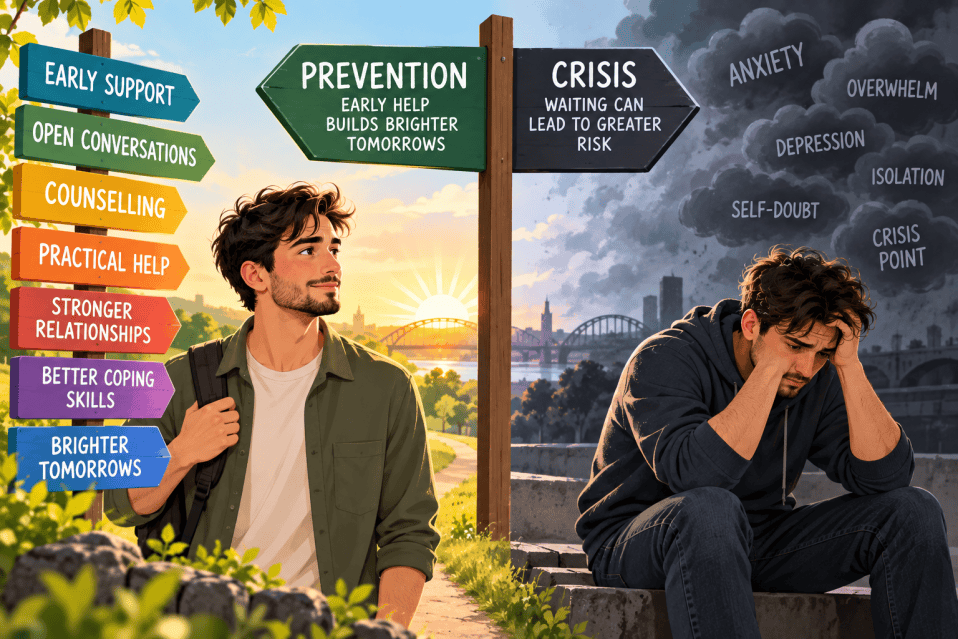
When it comes to mental health, too many people still receive support only after things have become unbearable.
They wait until anxiety is controlling everyday life.
They wait until depression has taken away motivation, relationships and hope.
They wait until trauma symptoms are affecting sleep, work and family life.
They wait until someone reaches crisis point.
By then, the person may need urgent or intensive support.
This is why prevention and early intervention in mental health are so important.
At Anxious Minds, we believe support should be available before someone reaches crisis.
People should not have to become seriously unwell before they are considered worthy of help.
Early mental health support can help people understand what they are experiencing, develop coping strategies, address practical problems and begin recovery before difficulties become more severe.
Prevention does not mean every mental health crisis can be avoided.
It means creating opportunities to intervene earlier, reduce risk and give people more support before their situation becomes overwhelming.
What Does Prevention Mean in Mental Health?
Mental health prevention is about reducing the likelihood that difficulties will become more severe.
This can include:
- Early access to counselling
- Mental health education
- Community support
- Peer support
- Workplace wellbeing programmes
- Suicide prevention
- Support after trauma
- Bereavement support
- Addiction recovery services
- Practical advice around housing or benefits
- Support for families and carers
Prevention can begin long before somebody develops a diagnosed mental health condition.
It can also involve helping someone who is already struggling before their symptoms escalate.
The principle is simple:
Help people earlier rather than waiting until they reach breaking point.
What Is Crisis Intervention?
Crisis intervention is support provided when somebody’s mental health has deteriorated to a point where they may be unable to cope safely.
This may involve:
- Severe depression
- Suicidal thoughts
- Serious self-harm
- Extreme anxiety or panic
- Severe trauma symptoms
- Psychosis
- Acute distress
- Inability to function safely
Crisis services are essential.
They can save lives.
But crisis intervention should not be the first opportunity someone has to receive meaningful mental health support.
A system that only responds when people become critically unwell is constantly reacting rather than preventing.
Mental Health Problems Often Develop Gradually
Many mental health crises do not begin with one sudden event.
They build.
Someone may first notice they are struggling to sleep.
Then they become more anxious.
Their concentration gets worse.
Work becomes harder.
They stop seeing friends.
They start drinking more.
They become increasingly isolated.
Eventually, several months of pressure can result in crisis.
At different points in that journey, there may have been opportunities to provide support.
That is where early intervention matters.
A conversation with a counsellor six months earlier may not solve every problem, but it might help someone recognise what is happening before things deteriorate further.
The Earlier Someone Gets Support, the More Options They May Have
When someone reaches crisis, choices can become limited.
The priority may simply be immediate safety.
Earlier intervention allows more time to understand what is happening and explore different forms of support.
This might involve:
- Counselling
- Lifestyle changes
- Practical advice
- Peer support
- Relationship support
- Workplace adjustments
- Addiction support
- Trauma-informed therapy
- GP support
The person may still be able to work, maintain relationships and stay engaged with everyday life.
This can make recovery less disruptive.
Prevention Can Reduce the Impact on Families
Mental health difficulties rarely affect only one person.
Families are often affected too.
Partners may become worried.
Children may notice changes.
Parents may provide financial or emotional support.
Friends may become carers.
When someone reaches crisis, the entire family can become involved.
Early support can help reduce some of this pressure.
For example, someone experiencing depression may begin withdrawing from family life.
Early counselling could help them understand their symptoms and communicate more openly before relationships become seriously strained.
Prevention is therefore not only about the individual.
It can protect families and wider support networks too.
Early Intervention Can Help Prevent Isolation
Isolation is one of the factors that can make mental health difficulties worse.
When people begin struggling, they often withdraw.
They stop answering messages.
They avoid social situations.
They may feel ashamed or believe nobody will understand.
The longer isolation continues, the harder it can become to reconnect.
Early support can interrupt this pattern.
A support group, counsellor, community service or trusted professional can provide connection before isolation becomes deeply established.
Sometimes simply having somewhere safe to go each week can make a major difference.
Prevention and Suicide
Suicide prevention is not only about responding when somebody is in immediate danger.
It also involves reducing the factors that can push someone towards crisis.
These may include:
- Depression
- Trauma
- Isolation
- Relationship breakdown
- Financial problems
- Housing insecurity
- Addiction
- Bereavement
- Chronic stress
Providing support with these issues earlier can reduce pressure.
It can help someone feel that there are options.
This is why suicide prevention needs to include counselling, community support and practical help alongside emergency services.
Mental Health and Practical Problems Are Often Connected
People’s mental health does not exist separately from the rest of their life.
Someone may feel anxious because they are facing eviction.
Another person may be depressed because they have lost their job.
Someone may be overwhelmed because they are caring for a relative.
Another person may be struggling because of debt.
If services only focus on symptoms while ignoring practical problems, recovery can be much harder.
Prevention works best when support looks at the whole person.
That can mean combining emotional support with advice, advocacy and practical help.
Prevention Can Reduce Pressure on Emergency Services
When community mental health support is difficult to access, people may eventually turn to emergency services.
Some may present at A&E.
Others may call emergency services during severe distress.
Crisis teams may become involved.
These services are essential, but they are designed to respond to urgent situations.
If more people can access effective support earlier, some crises may be prevented or reduced in severity.
This can allow emergency services to focus on people who genuinely require immediate intervention.
Prevention Is Usually Less Disruptive
A mental health crisis can disrupt almost every area of life.
Someone may need time away from work.
Relationships may become strained.
Finances may suffer.
Children may be affected.
Housing may become unstable.
Recovery can take months.
Earlier support may help prevent some of these consequences.
For example, someone experiencing severe anxiety may begin struggling at work.
If they receive counselling and workplace support early, they may remain employed.
Without support, their anxiety could worsen until they are unable to work.
The difference can be significant.
Prevention Can Be More Cost-Effective
Mental health crises can be expensive.
Costs may involve:
- Emergency healthcare
- Hospital treatment
- Long periods of sickness absence
- Lost employment
- Housing support
- Social care
- Family breakdown
- Criminal justice involvement in some cases
Prevention and early intervention can sometimes reduce these wider costs.
But cost should not be the only reason to invest in prevention.
The human cost matters too.
Avoiding months or years of unnecessary suffering has value in itself.
Counselling as Early Intervention
Counselling can play an important role in prevention.
Someone does not need to have a diagnosis or be in crisis before speaking to a counsellor.
They may simply know that something is wrong.
Counselling can help people:
- Understand their thoughts and emotions
- Recognise patterns
- Identify triggers
- Develop coping strategies
- Improve relationships
- Build confidence
- Process difficult experiences
- Reduce isolation
This can be particularly valuable when support begins early.
The aim is not always to wait until symptoms become severe enough to require intensive treatment.
Sometimes early conversations can prevent problems from becoming more complicated.
Workplace Prevention
Workplaces can also play an important role in mental health prevention.
Managers may notice changes before somebody reaches crisis.
An employee may become withdrawn.
Their performance may change.
They may appear exhausted.
Instead of immediately treating this as a performance issue, a supportive workplace can ask:
“Are you okay?”
This conversation can open the door to support.
Workplace prevention may include:
- Mental health awareness training
- Mental health first aid
- Counselling
- Flexible working
- Supportive management
- Reasonable adjustments
- Stress management
- Clear wellbeing policies
Healthy workplaces can help people stay well.
Supporting Young People Earlier
Prevention is especially important for children and young people.
Many adult mental health difficulties begin earlier in life.
Early support can help young people understand:
- Anxiety
- Emotions
- Stress
- Relationships
- Self-esteem
- Coping strategies
Teaching these skills before difficulties become severe can build resilience.
Young people should not have to wait until they are in crisis before somebody pays attention.
Schools, families and community organisations all have a role.
Supporting Veterans Before Crisis
Veterans may face unique barriers to asking for help.
Some are used to managing difficult situations independently.
Others may worry about stigma.
They may struggle with trauma, transition, relationships, addiction or isolation.
Some veterans wait years before accessing support.
Early intervention can provide support while someone is waiting for specialist services or before difficulties become severe enough to require complex treatment.
Community veteran services can also provide ongoing support after specialist treatment ends.
This continuity can help prevent people from falling through gaps.
Prevention After Trauma
Trauma does not always immediately result in PTSD.
Some people initially appear to cope well.
Symptoms may develop later.
Early trauma-informed support can help people understand normal trauma responses and recognise when additional help may be needed.
This does not mean forcing someone to discuss traumatic experiences before they are ready.
Good early support should focus on safety, information, practical support and access to appropriate professional care.
Prevention After Bereavement
Grief is not automatically a mental health disorder.
But bereavement can leave people vulnerable to depression, anxiety, isolation and trauma.
Support after loss can help people process emotions before they become overwhelmed.
This might include:
- Bereavement counselling
- Peer support
- Family support
- Practical help
- Community activities
Again, the goal is not to remove normal grief.
It is to make sure someone does not have to experience it completely alone.
The Problem With Long Waiting Lists
Early intervention becomes difficult when people cannot access support quickly.
Someone may recognise they need help and make the difficult decision to reach out.
If they then face a long wait, their condition may deteriorate.
During that period, they may lose hope.
They may withdraw further.
Their relationships or employment may suffer.
Community organisations can play an important role in providing early support while people wait for specialist services.
But these organisations need sustainable funding if they are going to meet demand safely.
The Importance of Community Mental Health Services
Community-based services are often easier for people to approach than formal clinical settings.
Someone may feel more comfortable walking into a local community centre than entering a hospital.
Community services can offer:
- Counselling
- Peer support
- Groups
- Advice
- Recovery programmes
- Social connection
- Practical support
They can also build long-term relationships with people.
This matters because mental health recovery does not always happen within a fixed number of appointments.
Some people need ongoing support.
Prevention Means Listening Earlier
We often notice mental health problems only when behaviour becomes difficult to ignore.
Someone stops attending work.
A relationship breaks down.
They begin drinking heavily.
They reach crisis.
But there were often signs earlier.
They may have said:
“I am exhausted.”
“I can’t switch my brain off.”
“I’m struggling.”
“I don’t feel like myself.”
We need to take these statements seriously.
People should not have to become visibly broken before they receive compassion.
Prevention Requires Accessible Services
Telling people to seek help is not enough.
Help has to be available.
Services need to be:
- Affordable
- Local
- Accessible
- Timely
- Non-judgemental
- Appropriate to individual needs
If someone finally asks for support and is told they must wait months, that opportunity for early intervention can be lost.
Good prevention means creating services people can access when they first realise something is wrong.
Prevention Does Not Replace Crisis Services
It is important to be clear.
Prevention cannot stop every mental health crisis.
Some people will still experience severe episodes even with good support.
Crisis services will always be necessary.
The point is not to choose between prevention and crisis intervention.
We need both.
But a balanced mental health system should not invest only in responding after people become seriously unwell.
It should invest in preventing avoidable deterioration too.
What Individuals Can Do
You do not have to wait until your mental health becomes severe before taking action.
Consider reaching out if you notice:
- Persistent anxiety
- Low mood
- Sleep problems
- Increased alcohol use
- Social withdrawal
- Difficulty coping with stress
- Repeated panic
- Trauma symptoms
- Loss of motivation
- Feeling overwhelmed
These signs do not mean you are failing.
They may simply mean you need support.
Early help can be easier than trying to recover after months of deterioration.
What Families Can Do
Families can also encourage early intervention.
If you notice someone changing, check in.
You might say:
“You don’t seem yourself lately. How are things?”
Avoid waiting until you know exactly what is wrong.
You do not need to diagnose them.
You simply need to open a conversation.
Sometimes knowing somebody has noticed can make it easier to ask for help.
A Better Approach to Mental Health
Imagine a mental health system where people can receive support when they first start struggling.
Where counselling is available before crisis.
Where veterans receive help while they wait for specialist treatment.
Where workplaces recognise mental health difficulties early.
Where bereaved people have somewhere to turn.
Where families can access advice before relationships collapse.
Where community organisations have the resources to provide long-term support.
Emergency services would still be needed.
But fewer people might have to reach the point where emergency intervention becomes their first real experience of mental health care.
That is the value of prevention.
Anxious Minds Is Here to Help
At Anxious Minds, our work is built around early intervention and ongoing mental health support.
We support people experiencing anxiety, depression, trauma, bereavement and other mental health difficulties.
Our services are designed to help people access support before things become more serious. We believe nobody should have to wait until they are completely overwhelmed before somebody listens.
Anxious Minds
Telephone: 0191 262 0305
If you or somebody else is in immediate danger or unable to remain safe, call 999 or attend your nearest Accident & Emergency department.
Mental health prevention is not about pretending crisis will never happen.
It is about making sure people have more opportunities for help before they get there.
Because sometimes the difference between early support and crisis intervention is simply whether somebody was able to reach the right help at the right time.


Post a comment